Understanding Renewable Natural Gas
What is Renewable Natural Gas?
Natural gas, which consists largely of methane, has traditionally been sourced from decomposing organic matter found underground (ie. fossils). However, there are other sources of decomposing organic matter that can generate natural gas. One example is a landfill, which produces gas from its decomposing organic waste. This gas, also known as biogas, can be captured and non-methane elements can be removed, resulting in Renewable Natural Gas (RNG). The resulting RNG is the same as and can be used interchangeably with traditional natural gas; the only difference is that this natural gas came from a landfill instead of a fossil.
Renewable Natural Gas can be produced from a variety of existing waste streams and renewable biomass sources, such as:
- Animal waste from dairies
- Food waste from landfills
- Woody biomass from agriculture and forestry
- Organic waste from wastewater treatment plants
- Organic waste from landfill-diversion facilities
You can use RNG to power equipment or vehicles that use natural gas, or to generate your own electricity on site. This can be a great way to save money and energy. Other benefits include:
- Capture emissions of unused "waste" methane
- Reduce the need for conventional fuel
- Cut production and waste disposal costs
RNG can be an important renewable energy tool because it is available anytime consumers need it. Wind and solar are intermittent energy sources – meaning the energy isn’t available when the sun isn’t shining, and the wind isn’t blowing. Waste material can be converted into deliverable, renewable energy 24 hours per day, seven days a week and can be deployed when and where it is needed through the pipeline network
Biogas is the raw gas produced from decomposing organic waste. It typically consists of mainly methane and carbon dioxide, along with traces of other elements. In order to become RNG, biogas needs to be cleaned and conditioned, which means removing or reducing non-methane elements such as carbon dioxide. This process generates a Renewable Natural Gas that’s completely interchangeable with traditional pipeline-quality natural gas and ensures safe and reliable operation of the pipeline network and customer equipment. RNG is extremely versatile and can be delivered anywhere along the nation’s extensive pipeline infrastructure.

Courtesy of the American Gas Association
The abundance of these materials allows for production of substantial quantities of biogas. Recent analysis for the California Energy Commission and Energy Vision indicate that RNG produced from California’s existing organic waste streams has the potential to supply on the order of 25–30% of the state’s total non-power-plant gas demand—enough to cover at least half, and potentially more than all, of current residential natural gas use, depending on how that supply is allocated.1
The 2024 California Gas Report, summarizing multiple studies, finds that in-state RNG from anaerobic digestion and non-combustion gasification of organic feedstocks could supply about 75% of California’s 2020 residential natural gas demand.2
The residential sector is the largest end user, making up about 38 percent of the natural gas usage in California.3
According the 2023 Billion-Ton Report (BT23), that has assessed renewable carbon resources, it has found that the nation can sustainably produce from 1.1 - 1.5 billion tons per year of biomass, tripling current U.S. bioenergy production while still meeting projected demand for food, feed, fiber, conventional forest products, and exports. The BT23 Report quantifies national biomass production capacity from 60 resources, including wastes, forestry, agriculture, and algae.4
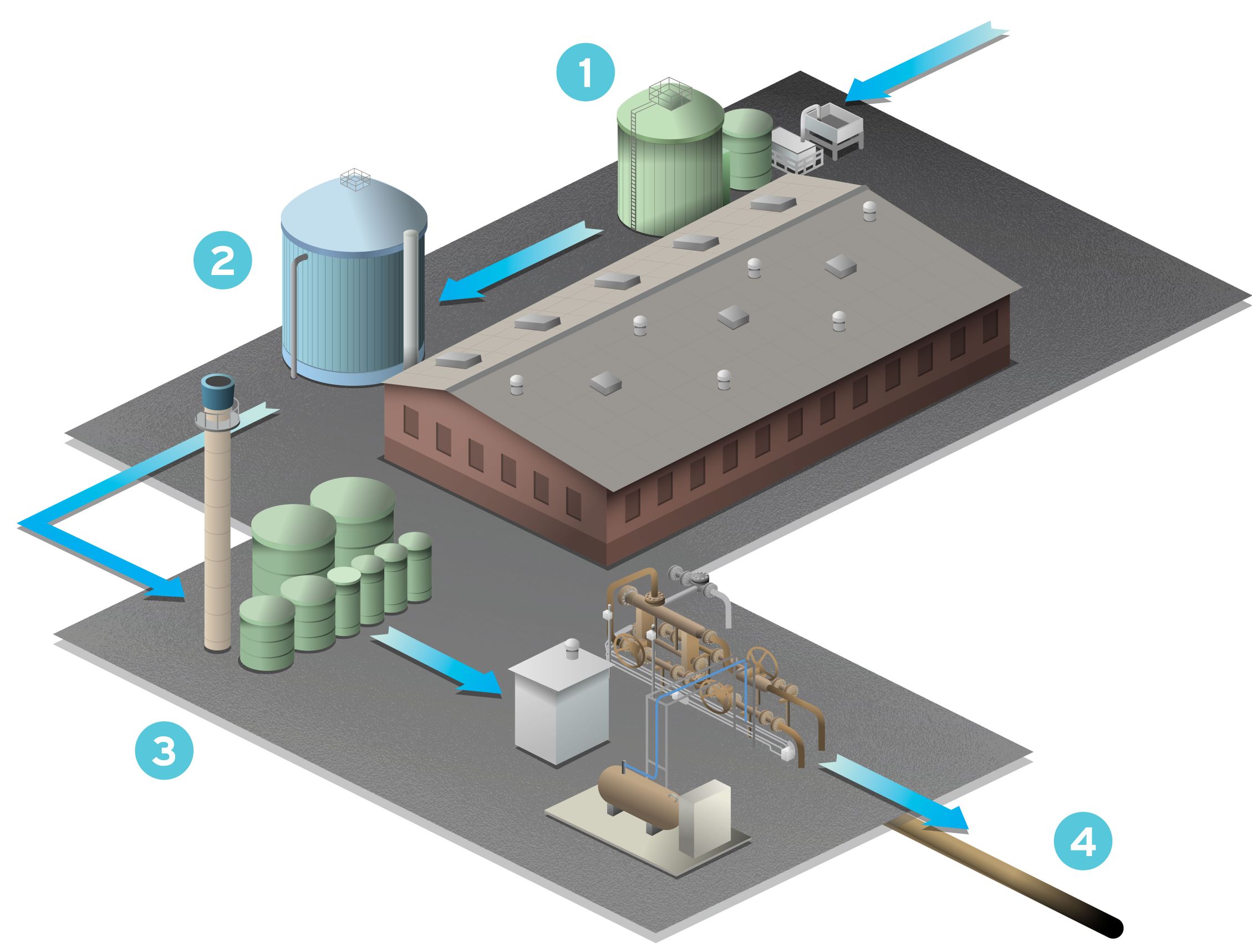
- Waste products, such as wastewater, food waste and manure are processed in a biodigester.
- The biodigester breaks down the organic material through an anaerobic process, creating biogas — a mixture of methane, carbon dioxide (CO2), and other gas constituents.
- Biogas is then conditioned and upgraded to remove the CO2 and other gas constituents, leaving a high concentration of methane. This produces renewable natural gas, or RNG, which can be used interchangeably with traditional natural gas.
- RNG can be used where it is produced for purposes such as generating electricity or fueling vehicles, or it can be injected into the utility pipeline and transported to an end user.
Reducing carbon dioxide and other greenhouse gas levels is important to help reduce global warming. RNG is considered a carbon-neutral fuel because it comes from organic sources that once absorbed carbon dioxide from the atmosphere during photosynthesis. RNG has even greater benefits when it’s produced from organic waste that would otherwise decay and emit methane emissions into the atmosphere. By capturing more greenhouses gases than it emits, this RNG can be considered carbon-negative!
SoCalGas® is a Supporter of Biogas Development and California’s Economy
As part of our commitment to helping the environment and supporting California in meeting its greenhouse gas reduction goals, SoCalGas offers expertise and assistance to customers who want to convert organic waste material into biogas or RNG. Through our network of natural gas pipelines, SoCalGas offers the opportunity for RNG to be accepted into our transmission and distribution system and delivered to our customers. Converting waste products into RNG can help California meet its energy needs with local resources. Investing in RNG production in California can help create jobs in all regions of the state while improving air quality by better managing our waste streams.
1 The Power of Waste: Renewable Natural Gas for California Prepared by: Energy Vision and Renewable Natural Gas in California Characteristics, Potential, and Incentives: 2023 Update Prepared for: California Energy Commission Prepared by: Verdant Associates
22024 California Gas Report, Prepared by the California Gas and Electric Utilities
42023 Billion-Ton Report: An Assessment of U.S. Renewable Carbon Resources, Prepared by the U.S. Department of Energy and U.S. Department of Energy Website